In August 2026, Limerick Racecourse will host the FISO OCR World Championships — bringing more than 4,000 athletes from over 60 countries to Ireland for the most prestigious obstacle course racing event in the world, just two years before the sport makes its Olympic debut in Los Angeles. It is a remarkable moment for Irish sport, and for anyone who has been curious about obstacle course racing without quite knowing where to start, there has never been a better time to find out what it involves.

What Obstacle Course Racing Actually Is
Obstacle course racing combines running with a series of physical challenges — walls to climb, structures to traverse, mud to crawl through, water crossings, carrying events, balance obstacles and rope climbs — across distances that typically range from 5km at the shorter end to 15km or more for endurance events. The sport sits in a broad category that includes everything from the competitive elite formats that will be on display in Limerick to the non-competitive fun events that have introduced hundreds of thousands of Irish people to the outdoors over the last decade.
What distinguishes OCR from trail running or adventure racing is the obstacle element — the physical problem-solving component that tests upper body strength, grip, coordination and courage alongside the cardiovascular demand of covering the distance. A course designer's job is to find the right combination of natural terrain and constructed challenges that tests the whole athlete, not just their running fitness. Ireland's landscape — its hills, bogs, rivers and forests — makes it particularly well-suited to this kind of event, which is part of why the OCR scene here has developed the way it has.
The sport has its own governing body, FISO — the Fédération Internationale de Sports d'Obstacles — and its own national association in Ireland, OCRA Ireland, which has been central to the bid that brought the World Championships to Limerick. Its confirmation as an Olympic sport for Los Angeles 2028 has significantly raised the profile and the competitive structure of the discipline globally, and Ireland is well-positioned to benefit from that trajectory given the quality of the events, terrain and community already in place here.
The OCR World Championships Limerick 2026
The FISO OCR World Championships 2026 take place at Limerick Racecourse from August 6 to 9, with the University of Limerick serving as the official Athlete Village. More than 4,000 athletes from over 60 countries are expected to compete, making it one of the largest international sporting events ever staged in the region, with organisers projecting a €2.8 million economic impact for the wider Mid-West.
The World Championships will feature a range of formats, from short and explosive 100m and 400m sprints to 2–3km technical courses, a 15km endurance race and high-energy team relays. The competition is open to professionals, age group athletes, Para-OCR competitors and dedicated amateurs.
The timing is significant beyond the event itself. The championships arrive just two years before the sport is set to make its official debut at the Los Angeles 2028 Olympic Games. Ireland hosting the pre-Olympic World Championships is a statement about the strength of the national scene and the quality of the bid put together by OCRA Ireland, Shannon Region Conference and Sports Bureau, the University of Limerick and Limerick Racecourse.
For spectators and first-timers alike, the event is worth attending regardless of whether you plan to race. World Championship OCR at the elite level is a genuinely spectacular thing to watch, and the atmosphere around a large international event of this kind — thousands of athletes, dozens of nationalities, the full range of formats running across several days — gives a very different picture of the sport than the local fun run formats most Irish people are familiar with.
Irish OCR Events in 2026
Beyond the World Championships, Ireland's domestic OCR calendar in 2026 offers several well-established events that are well-suited to beginners and returning participants alike.
Hell and Back is the longest-running and most widely recognised OCR event in Ireland, held at Killruddery Estate on the edge of the Wicklow Mountains. Hell and Back returns on Saturday 6 June 2026 with two course options — 8km and 13km — making it accessible to first-timers while still offering a genuine challenge for more experienced participants. The estate's natural terrain — forests, bogs, rivers and hillside — provides the backdrop, with constructed obstacles adding the technical challenge. Hell and Back has a well-deserved reputation as the event that introduces most Irish people to obstacle racing, and its non-competitive waves and inclusive atmosphere make it an ideal starting point.
Turf Warrior takes place on 8 August 2026 beside Killary Fjord in Connemara — one of the most spectacular natural settings of any event in Ireland. The 7km course runs through forests, bogs and rivers, finishing in Killary Fjord itself, combining the dramatic Connemara landscape with constructed obstacles. The west of Ireland setting and the combination of natural and man-made challenge make Turf Warrior a distinctive event with a strong following among those who return year after year.
The FISO OCR World Championships at Limerick Racecourse from 6 to 9 August offers open participation categories alongside the elite competitive formats — meaning that if you want to experience World Championship obstacles without the pressure of international competition, there is a route in. Check the official event website at ocrwc2026.com for registration details and open category availability.
OCRA Ireland's website and the Running Calendar Ireland are the most reliable sources for additional events as they are confirmed throughout the year. The calendar tends to be busiest from May through September, with events spread across most provinces.
Is It for You — What to Expect as a First-Timer
The most common misconception about obstacle course racing among people who have not done it is that it requires a high baseline level of athletic ability. It does not — at least not for most Irish events at beginner level. What it requires is a reasonable base of general fitness, a willingness to get cold and wet and muddy, and the ability to manage the occasional moment of genuine discomfort without it stopping you.
Most events offer non-competitive participation waves where there is no timing pressure and where obstacles can be modified or skipped without penalty. This matters more than it might seem for a first-timer — knowing that the event is yours to complete at your own pace, in your own way, removes a significant amount of the anxiety that keeps people from signing up at all.
The community aspect of OCR is one of its most distinctive features and one of the things that surprises first-timers most consistently. The culture around obstacle racing — at least in the Irish domestic events — is genuinely inclusive and encouraging. Strangers help each other over walls. Faster participants circle back to help slower ones. The atmosphere at the finish is celebratory regardless of time. This is not a feature of every sporting event, and it is one of the reasons so many people who do one OCR event end up doing another.
The physical experience itself — the combination of running, climbing, crawling and carrying in a natural outdoor setting — engages the body in a way that gym-based training and road running rarely do. Many participants describe their first event as genuinely fun in a way they did not expect, and the memory of specific obstacles, specific moments of difficulty overcome, tends to stay with people in a way that a timed road race does not.
How to Train for Your First Event
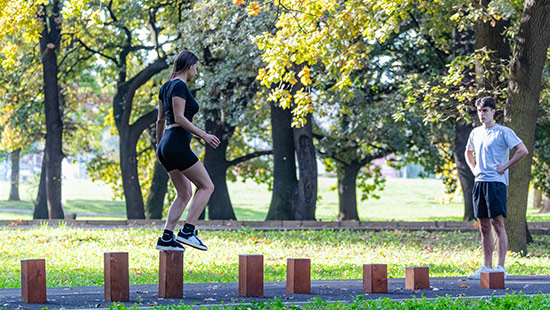
Training for a beginner OCR event does not require a specialist programme. A combination of three elements covers the majority of what most 5 to 8km Irish events demand.
Running base. You do not need to be fast, but you need to be comfortable running for 45 to 60 minutes without stopping. If you are starting from scratch, a couch-to-5k programme followed by a few weeks of extending the distance gets most people to this point within ten to twelve weeks. Trail running is better preparation than road running if you have access to it — the uneven terrain, the elevation changes and the concentration required to manage your footing are all directly relevant to what you will encounter on a course.
Upper body pulling strength and grip. This is the most common limiting factor for beginners on obstacle courses. The climbing walls, rope climbs, monkey bars and ring traverses that appear in most events require genuine pulling strength and grip endurance. If you cannot currently do a pull-up, adding an assisted pull-up progression and dead hangs to your training two or three times a week will produce significant improvement over twelve weeks. Farmer carries — walking with heavy objects held at your sides — build the grip endurance that hanging obstacles require.
Carrying and crawling. Most events include at least one carrying obstacle — sandbags, buckets of water, logs — and crawling sections under barbed wire or through mud. Neither requires specific training, but practising bear crawls and loaded carries in your preparation removes their unfamiliarity on race day, which matters when you are already tired.
For children and younger participants, the skills developed through ninja training translate directly to OCR — the climbing, swinging and obstacle work covered in a good kids ninja programme provides exactly the upper body and coordination foundation that young participants need for their first event. Many families approach OCR as a shared activity, and most Irish events offer junior and family categories.
The Bigger Picture
The arrival of the OCR World Championships in Limerick in 2026 is not just a sporting event. It is a signal about where this sport is going. Olympic confirmation for Los Angeles 2028, a structured international governing body, national federations in place across more than 60 countries, and a domestic Irish scene with deep roots and genuine community — the conditions for OCR to establish itself as a mainstream sporting pursuit in Ireland are better now than they have ever been.
For anyone on the fence about signing up for their first event, the calendar this year provides more than enough options across formats, distances and locations to find something that fits. The sport rewards the qualities that most people who train seriously already have — persistence, a tolerance for discomfort, the willingness to attempt something hard without knowing in advance whether you will succeed. Those qualities are not specific to OCR. But OCR is one of the more direct ways of finding out whether you have them.
Frequently Asked Questions
Obstacle course racing combines running with a series of physical challenges — walls, climbing structures, mud crawls, water crossings, carrying events and balance obstacles — across distances typically ranging from 5km to 15km or beyond. Events range from non-competitive fun runs to elite competitive formats. The sport has been confirmed for the Los Angeles 2028 Olympic Games, making it one of the fastest-growing competitive sports in the world.
Yes. Most Irish OCR events are specifically designed to be accessible to first-timers, with shorter course options, non-competitive waves, and the option to skip or modify obstacles. You do not need to be a strong runner or an experienced athlete to complete your first event. A basic level of general fitness and a willingness to get muddy are the main requirements.
The 2026 FISO OCR World Championships takes place at Limerick Racecourse from August 6 to 9, 2026, with the University of Limerick serving as the official Athlete Village. More than 4,000 athletes from over 60 countries are expected to compete across formats including 100m sprint, 400m sprint, 2–3km technical courses, a 15km endurance race and team relays. The event is open to elite, age group, adaptive and amateur participants.
A combination of running fitness, upper body pulling strength and grip endurance covers the majority of what most beginner OCR events require. Building a base of 3–5km running comfort, adding pull-up and hanging work for grip and upper body, and including some carrying and crawling drills in training will prepare most people adequately for a first event. Twelve weeks of consistent training is sufficient for most beginners targeting a 5–8km event.
Confirmed 2026 events include Hell and Back at Killruddery Estate in Wicklow on 6 June (8km and 13km options), Turf Warrior at Killary Fjord in Galway on 8 August, and the FISO OCR World Championships at Limerick Racecourse from 6 to 9 August. Check OCRA Ireland and individual event websites for the most current information on additional events and registration.
Related Articles
Ninja Training for Kids — What It Is and Why It Builds Confidence
Ninja training combines obstacle work, movement skills and structured challenge in a way that genuinely engages children — especially those who struggle with traditional team sports.
Read Article
Breathwork and Martial Arts — How Breathing Shapes Performance and Resilience
Breath is the bridge between the physical and mental sides of training. How you breathe under pressure determines how well you think, how efficiently you move, and how quickly you recover.
Read Article