Most people who train focus on what their body is doing — technique, timing, strength, conditioning. Breath is the thing that connects all of it, and it is almost never explicitly taught outside of traditions that have understood its importance for centuries. That gap is not trivial. How you breathe under pressure determines how well you think, how efficiently you move, and how quickly you recover. It is the most direct voluntary lever you have over your own nervous system, and learning to use it changes everything from performance in training to how you handle stress in daily life.
What Actually Happens When You Breathe Under Pressure
To understand why breath matters in training, it helps to understand what happens to it when stress hits. The moment the body perceives a threat — physical, emotional or social — the sympathetic nervous system activates. Heart rate rises, muscles tense, blood is redirected to the large muscle groups, and breathing becomes faster and shallower. This is the fight-or-flight response, and it is extraordinarily useful in a genuine emergency. The problem is that it also narrows attention, reduces fine motor control and degrades the kind of clear, flexible thinking that skilled martial arts performance requires.
This is the same mechanism we explored in the context of psychological self-defence — the stress response that turns otherwise reasonable people into poor decision-makers in confrontational situations. The breath is not separate from that process. It is central to it. And crucially, it is the one part of the stress response you can consciously override.
Slow, deliberate breathing — particularly a longer exhale than inhale — activates the parasympathetic nervous system, the body's rest-and-recovery state. This happens via the vagus nerve, which connects the brain to the heart, lungs and digestive system and responds directly to the rhythm of the breath. Research published in PMC has confirmed that slow, nasal, diaphragmatic breathing significantly improves vagal tone and heart rate variability — a measure of the nervous system's ability to adapt to changing conditions — while reducing cortisol, anxiety and the physiological markers of chronic stress.
In practical terms, this means that a practitioner who has trained their breath can walk into a high-pressure situation — a sparring round, a grading, a real-world threat — and maintain access to their full range of function. A practitioner who has not trained their breath will be at the mercy of whatever their nervous system decides to do when the pressure rises.
How Different Traditions Approach Breath
Every serious martial arts tradition has developed an approach to breath, and while the terminology and techniques differ, the underlying understanding is consistent. Breath is not incidental to the practice. It is foundational to it.
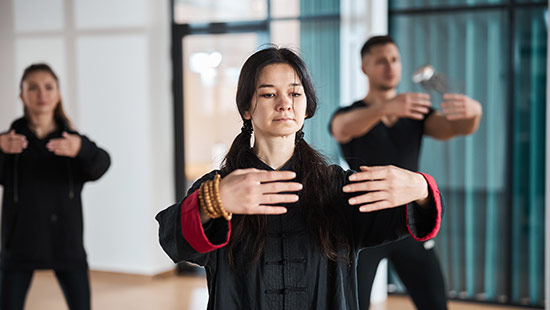
In tai chi, breath is integrated into every movement of the form. The general principle is that expanding movements — those where the body opens or extends — are accompanied by an inhale, while contracting or closing movements are accompanied by an exhale. In more advanced practice, the breath is coordinated with the movement of qi through the body and concentrated in the dan tian, the energy centre located just below the navel. Beginners are usually advised simply to breathe naturally and allow the coordination to develop over time — but the breath awareness that tai chi cultivates is one of its most transferable gifts, as older practitioners consistently report in terms of reduced anxiety and improved sleep.
In karate, the kiai — the sharp exhalation that accompanies a strike — is one of the most visible expressions of breath in martial arts and one of the most misunderstood. It is not a shout. It is the audible result of a full, explosive exhalation that tenses the core, maximises force transfer and simultaneously prepares the body to receive impact. Done correctly, the kiai is also a reset — it empties the lungs, forces a subsequent inhale, and briefly re-synchronises breath with movement. Karate kata also contain specific breathing patterns, some of which are taught openly and some of which are transmitted only in advanced instruction.
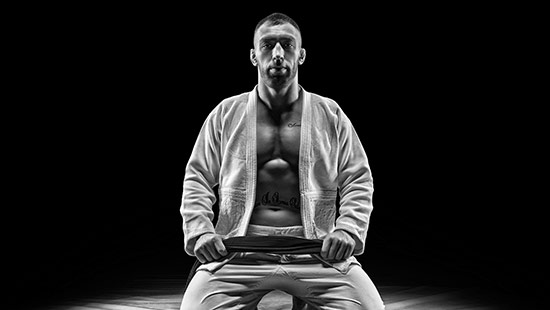
In judo, the exhale is used to protect the body during throws and falls. A judoka who is thrown while holding their breath risks serious injury from the sudden impact. The practice of ukemi — breakfalling — is inseparable from breath training, and experienced judoka develop an almost reflexive exhale on contact with the ground. This is breath as protection, and it is learned through thousands of repetitions until it becomes automatic.
In Zen-influenced martial arts such as aikido and kendo, breath practice extends into formal meditation. The concept of kokyu — breath power — in aikido describes the integration of breath, timing and whole-body movement into a unified expression of force. Morihei Ueshiba, aikido's founder, described breath as the thread connecting heaven and earth and placed kokyu training at the centre of his curriculum. This is not mysticism for its own sake — it describes a real phenomenon that any practitioner who has trained seriously for long enough will recognise: the moments when breath, movement and intention align and the technique becomes effortless.
The Missing Element in Most People's Training
Despite the centrality of breath in every serious tradition, explicit breathwork instruction is absent from most modern martial arts classes. Students are told to breathe — not to hold their breath, to exhale on effort — but the deeper curriculum of breath regulation, the techniques that allow a practitioner to genuinely manage their nervous system under pressure, is rarely taught as a subject in its own right.
This gap matters more than most coaches acknowledge. A student who trains for years without breath awareness will plateau in ways that more technique, more conditioning and more mat time cannot address. The ceiling on technical performance under genuine pressure is set partly by nervous system regulation, and nervous system regulation is set partly by breath. This is why practitioners who cross-train in qigong or tai chi alongside a harder martial art frequently report breakthroughs in their primary discipline — they are filling the breath gap that their main training left open.
The same is true outside the dojo. The samurai tradition understood that the development of physical capability without the internal cultivation to support it was incomplete — and the breath practices embedded in traditional martial arts training were part of that internal curriculum. Strip them out and you have athletes. Keep them in and you have something closer to what the original traditions were pointing at.
Three Breathing Techniques Worth Learning
Diaphragmatic breathing is the foundation of everything else and the thing most adults have lost through years of shallow chest breathing. Lie on your back with one hand on your chest and one on your belly. Breathe in through the nose. The belly hand should rise first, the chest hand should barely move. This is the breath pattern the body uses naturally in deep sleep, and it is the pattern that engages the diaphragm fully and activates the parasympathetic response most effectively. Five minutes of this daily, practised consistently, produces measurable changes in resting heart rate variability within weeks.
Box breathing is the technique most widely used in combat sports and military contexts for rapid recovery of composure under pressure. Inhale through the nose for a count of four. Hold for four. Exhale slowly for four. Hold the exhale for four. Repeat. The equal-ratio structure of box breathing is particularly effective at resetting a activated nervous system — the holds interrupt the shallow rapid rhythm of the stress response and give the body time to shift into the parasympathetic state. It can be used before training, between rounds, or in any everyday situation where pressure is rising and clear thinking is required.
Extended exhale breathing is the simplest and most portable of the three. Inhale for four counts, exhale for six to eight. The extended exhale is the most direct trigger for the vagal response — because heart rate decreases on the exhale, deliberately lengthening it produces a faster and more pronounced calming effect than any equal-ratio pattern. This is the technique most easily used in real time — in a training situation, in a conversation that is becoming tense, in any moment where the body is moving toward the stress response and you want to redirect it.
Where to Start
The most useful thing you can do with this information is not to read more about it. It is to practise one technique for two to three minutes a day for two weeks and notice what changes. The physiology is not complicated, and the benefits are not theoretical — they are produced by repetition over time, in the same way that any other physical skill is developed.
If you already train in a martial art, bring breath awareness into your existing practice. Notice where you hold your breath. Notice what happens to your technique when you exhale on effort versus when you forget to. Notice how your composure in sparring or in pressure situations correlates with the quality of your breathing in those moments. The feedback is immediate and consistent, once you know what to look for.
If you are new to movement practice entirely, tai chi is one of the most effective entry points — not only because it integrates breath with movement from the first lesson, but because its slow, deliberate pace gives you the space to actually notice what your breath is doing. That noticing is, in many ways, the whole practice.
Frequently Asked Questions
Breathwork in martial arts refers to the deliberate use of controlled breathing patterns to regulate physical performance, manage the stress response and develop mental composure under pressure. It takes different forms across traditions — kiai in karate, dan tian breathing in tai chi, pranayama in yoga-influenced arts — but the underlying principle is consistent: breath is the most direct voluntary tool for regulating the nervous system.
Controlled breathing directly affects the autonomic nervous system, which governs the stress response. When the body is under threat, breathing naturally becomes fast and shallow, which amplifies anxiety and reduces coordination. Deliberate slow breathing counteracts this by activating the parasympathetic nervous system — the rest and recovery state — which allows the practitioner to remain functional under pressure rather than being overwhelmed by it.
Box breathing involves inhaling for a count of four, holding for four, exhaling for four and holding again for four before the next inhale. It is used by military personnel, combat sports athletes and martial arts practitioners as a rapid method of re-establishing composure under stress. The structured equal-ratio pattern is particularly effective at reducing heart rate and restoring cognitive function when the stress response has been activated.
They overlap but are not the same. Breathwork specifically involves deliberate manipulation of breathing patterns to produce physiological and psychological effects. Meditation may use the breath as an anchor for attention without actively controlling it. In martial arts traditions, both approaches are used — breathwork for immediate regulation under stress, meditation for longer-term development of composure and focus.
Yes. A meta-analysis of randomised controlled trials found that breathwork interventions produce significant reductions in stress, anxiety and depression. The physiological mechanism — slow breathing activating the parasympathetic nervous system via the vagus nerve — operates the same way whether you are on a training mat or in an everyday high-pressure situation. The skills transfer directly.
Related Articles
Meditation for Martial Artists — Focus, Discipline and the Quiet Mind
In every serious martial arts tradition, mental training sits alongside physical training. This guide covers the practices that have shaped the discipline for centuries and how to begin.
Read Article
Psychological Self-Defence — The Mental Side of Personal Protection
The most dangerous moment in any confrontation is the one before it becomes physical. Awareness, ego management and the decision to walk away are the foundations trained practitioners build first.
Read Article